
LEARN VISUALLY · API foundations
Pagination: why an item can appear twice—or vanishOrder the records before dividing them into pages
Compare offset and cursor pagination with a changing SQLite dataset, define a stable sort order and explain why a cursor is not a frozen snapshot.
You read the first page of a lesson list. A new lesson arrives. On the next page, an article you already saw appears again. The database may be following the query exactly while the interface violates your expectation.
Jump to a section
The big picture
Open full-size diagram ↗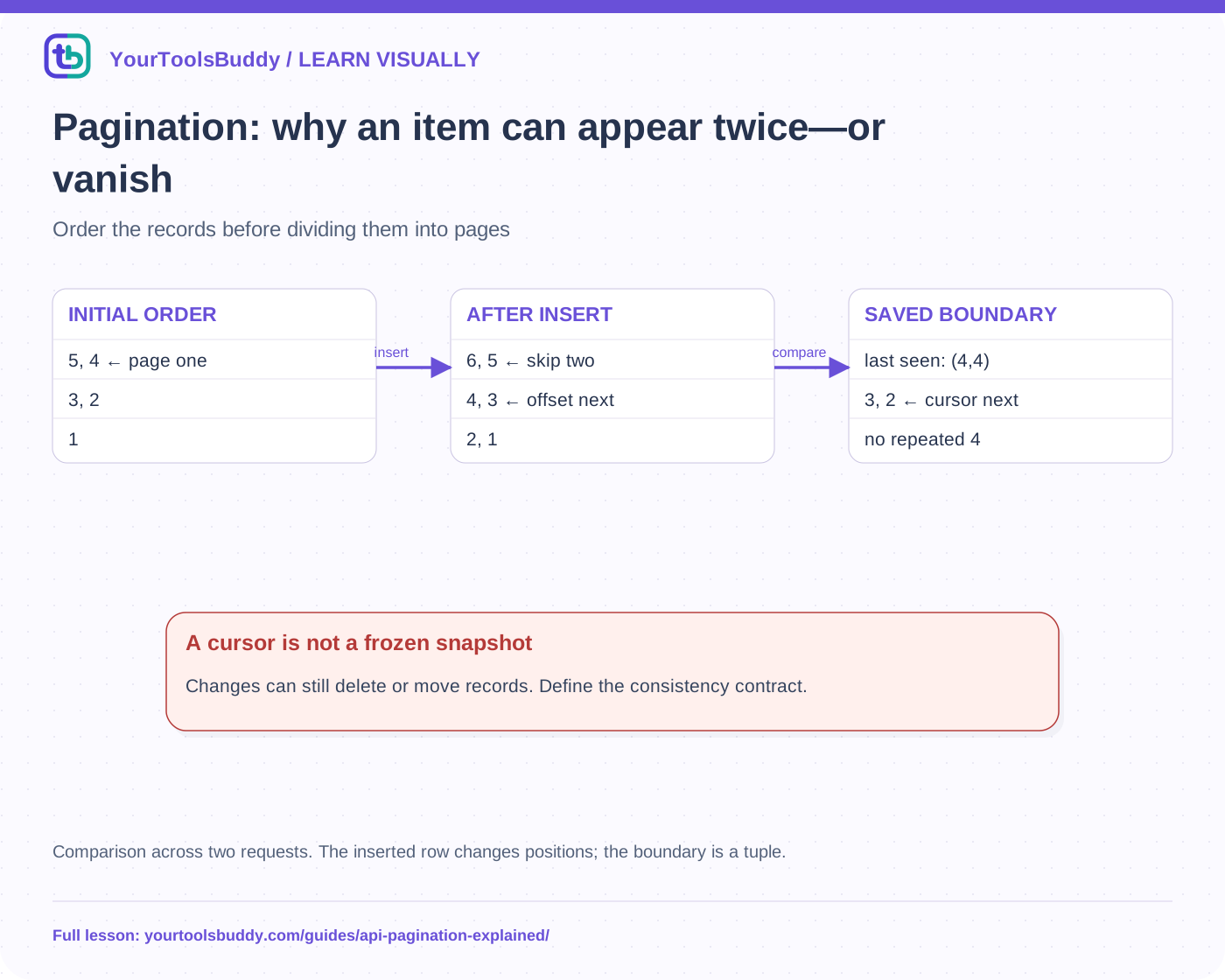
The diagram’s relationships are explained in the readable cards below. Open the full-size SVG to zoom.
Download branded diagram (SVG)Read the diagram
Comparison across two requests. The inserted row changes positions; the boundary is a tuple.
Page one
Initial ids: 5, 4
Insert
New id 6 moves positions
Offset next
Current positions: 4, 3
Cursor next
After saved boundary: 3, 2
Define one complete order
Our fictional feed sorts lessons by publication time descending and uses id descending to break ties. The second field matters because two lessons can share the same time. Without a unique ordering, “the next two records” is ambiguous even before anyone edits the data. SQL does not promise a particular result order just because it looked consistent in an earlier run.
Choose the order the product actually needs. Newest publication is different from latest edit, and alphabetical order answers another question. If an update changes a sort key, the record can move. Record that behavior in the API contract rather than letting the UI infer stability from the word “page.”
Offset counts positions in the current result
With LIMIT 2 OFFSET 0, our initial ordered ids are 5 and 4. The next offset would skip two rows. Before that request, insert new id 6 at the front. The current result begins 6, 5, 4, 3. Skipping two now returns 4 and 3, so id 4 repeats from the first page.
Deleting a row before the next offset can instead make the client skip an item it has not seen. Offset pagination is not inherently wrong: it can be convenient for bounded lists and page-number navigation. The issue is whether its behavior under change matches the reader’s expectation. Large offsets can also require substantial work; measure the chosen engine and query.
A cursor describes a continuation boundary
A keyset-style continuation can say “return records after the last tuple I saw.” In our descending example, the boundary after id 4 is its publication time and id. The next query selects strictly smaller ordered tuples, rather than skipping a count of current rows. Adding id 6 ahead of that boundary does not cause id 4 to reappear.
For equal timestamps, include the id tie-break in the boundary condition. Using only a date can skip all other records sharing that date. A cursor may encode the boundary opaquely, but encoding is not encryption or authorization. Validate its structure and bind it to the intended filters and ordering. Keep private information out of a casually exposed token.
A cursor is not a snapshot
Continuation helps with certain changes, but records can still be deleted, edited or moved across the boundary. If a product needs a consistent point-in-time report, it may need a snapshot or other database/application mechanism. Neither a cursor nor deduplication in the browser creates that guarantee by itself.
Also define whether new items should appear during a reading session. A feed may offer “new lessons available” and refresh from the top rather than inserting cards above a reader mid-scroll. Stability and freshness are product choices that can conflict. There is no single correct behavior for every catalogue or audit report.
Execute the changing-list example
The companion fixture uses real in-memory SQLite queries with deterministic ids. It checks the initial page, insertion before an offset, the duplicated offset result and a keyset result without that duplicate. A second check gives two records the same timestamp and confirms that the composite boundary retains the remaining item.
This is database query evidence, not a deployed API, a signed-cursor implementation or a performance measurement. The public-looking identifiers are synthetic. Predict each result before running the fixture so a green assertion does not replace understanding of which rows were included.
Design the API response around the reader
Return the requested records and an explicit next-page indication under the service’s contract. Avoid guessing “there must be another page” from a full result alone if the API has a reliable continuation field. Handle expired or invalid continuations with a useful recovery path. Limit page size, authorize every request and prevent endless loading when no next page exists.
Limits
We demonstrate descending keyset continuation and ordinary offset queries. Distributed snapshots, arbitrary sorting, signed cursors and concurrent transaction isolation need additional design. The fixture does not claim that cursor pagination is always faster or preferable. Use the smallest approach that satisfies the list’s real consistency and navigation requirements.
Work through the checked example
Input
Initial ids descending: 5,4,3,2,1
Read page [5,4], then insert 6
Tie case: (published=3,id=7) and (3,3)
Expected result
Offset 2 next: [4,3] (4 repeats)
After boundary (4,4): [3,2]
After boundary (3,7): [3]
What if it fails?
Real SQLite queries. No frozen snapshot, cursor signature or deployed API guarantee.
Original synthetic teaching fixture. No remote connection or real account is used.
References
Sources used to check the explanations and examples are listed below.
Found a mistake? Send a correction with this lesson’s title, URL and disputed detail. No login needed.
Continue learning
Database indexes: faster lookups have a cost →
SQL joins: explain every row in the result →
All visual lessons and practical guides →