
LEARN VISUALLY · Web basics
How search engines find a page—and decide whether to show itDiscovery is the beginning, not the finish line
Separate discovery, crawling, indexing and search results, then diagnose a fictional missing page without confusing a sitemap with a ranking guarantee.
You publish a helpful article, add it to your sitemap and search for its title. Nothing appears. Before changing the article, find out which part of the journey you actually have evidence for.
Jump to a section
The big picture
Open full-size diagram ↗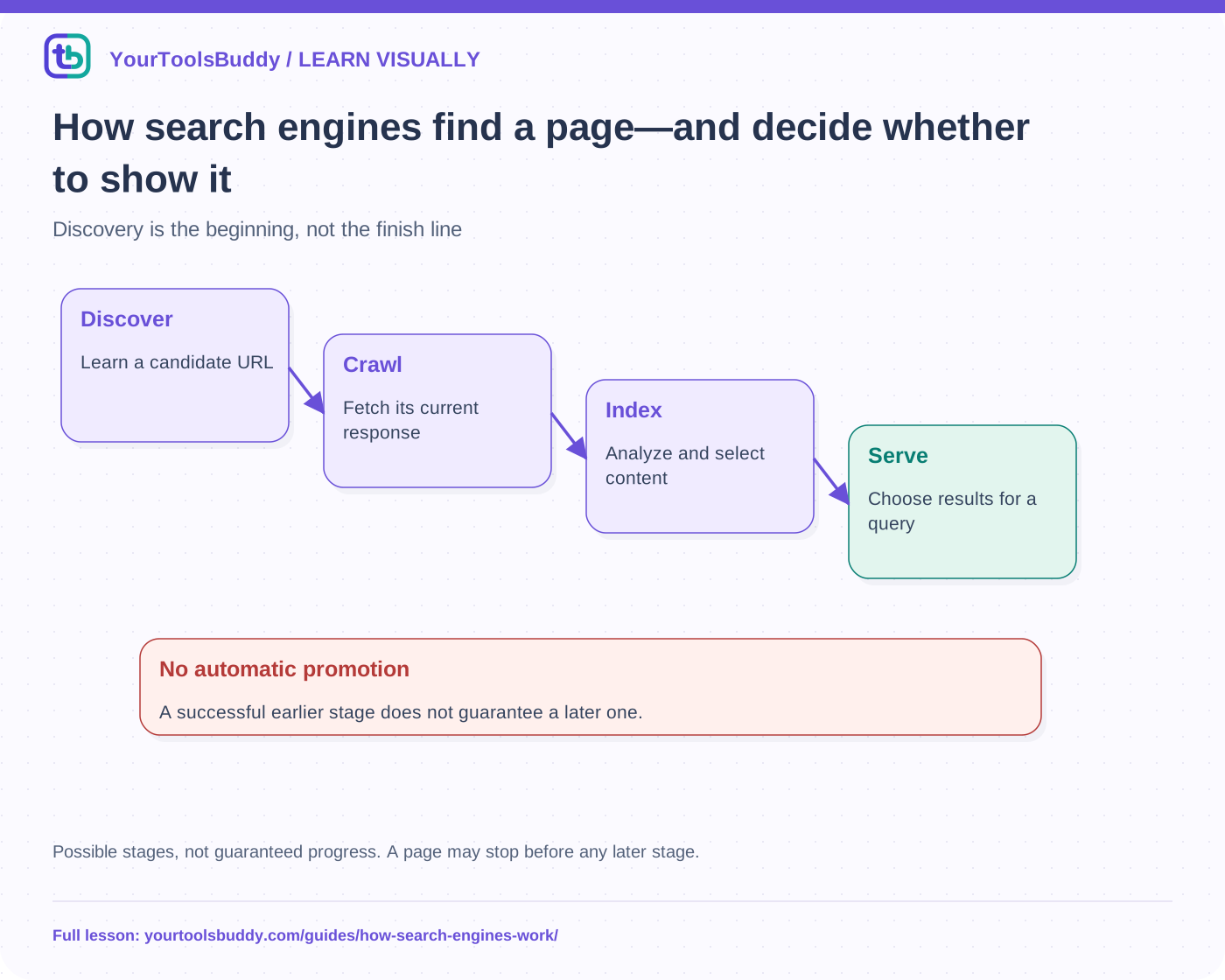
The diagram’s relationships are explained in the readable cards below. Open the full-size SVG to zoom.
Download branded diagram (SVG)Read the diagram
Possible stages, not guaranteed progress. A page may stop before any later stage.
Discover
Learn a candidate URL
Crawl
Fetch its current response
Index
Analyze and select content
Serve
Choose results for a query
A page can exist without being discovered
A fictional cycling club publishes a repair guide at /guides/fix-a-puncture/. Members can open the address, but the guide has no links from the club’s other pages. A visitor with the address can reach it; a crawler still needs a way to learn that it exists. This is the difference between availability and discovery. Start with a crawlable link from a useful directory and an accurate sitemap, rather than assuming that publication announces the page to every search engine.
A sitemap supplies candidate URLs. It does not buy a place in the index, reserve a ranking or prove that a crawler has fetched the latest content. A successful sitemap report means something narrower than successful search acquisition. Keep the submission date, last-read date and URL inspection result separate when investigating a page.
Crawling retrieves something; check what it retrieved
After discovering a URL, a search engine may request it. The response can be a useful article, a redirect, an error or a successful status containing the wrong screen. Our club’s server might accidentally return a login page with status 200. An uptime monitor would see a response, but the intended guide would still be missing. Inspect the returned content and final URL, not just the status number.
Robots.txt primarily controls crawler access. It is not a secure way to hide a private article, and blocking crawling can prevent Google from seeing an indexing instruction inside the page. Use proper access control for private material. For public material that should not appear in search, follow the search engine’s documented indexing controls rather than combining directives by guesswork.
Indexing is analysis and selection
Google describes indexing as analyzing fetched content and deciding what to store. Similar URLs can be grouped and a canonical selected. A preferred canonical is a signal, not a command that forces a particular decision. A duplicate print view and the normal repair guide do not necessarily need separate search entries. The useful question is whether the intended canonical can be found, rather than whether every alternate address is indexed.
If a report says the guide was crawled but is not indexed, repeated submissions are not a diagnosis. Check whether the page has a distinct purpose, useful accessible content and a consistent canonical. Preserve dated observations so you can tell a new finding from a delayed report. Search-engine reports can update after the actual crawl.
Serving results is another decision
An indexed repair guide is eligible to be considered for relevant searches, but eligibility does not guarantee an impression. The query, relevance and competing information matter. A search for a nearby repair shop has a different intent from a search for instructions. Explain the job the article solves, then evaluate impressions and clicks for that job rather than chasing an unrelated popular phrase.
An impression is a reported appearance in search; a click is an action from the result. Neither is a count of all website visitors. Direct visits, referrals and bots are separate. Avoid treating one successful title search on your own device as a representative ranking measurement.
Work through four support notes
Note A says “URL included in sitemap.” Note B says “crawler fetched the correct guide.” Note C says “canonical page indexed.” Note D says “12 impressions, one click for the stated period.” These notes support increasingly different conclusions, not four versions of the same success. Our local exercise classifies the notes; it does not contact Google or reproduce Google’s ranking algorithm.
A practical investigation order
Confirm the exact address, public response and useful content first. Check internal discovery and sitemap inclusion next. Then inspect indexing and canonical information. Finally examine complete search periods, relevant queries and page-level counts. Repair a demonstrated defect before rewriting a title. If the sample is tiny, preserve the page and observe rather than claiming that every daily fluctuation proves an improvement.
What this explanation does not promise
There is no fixed deadline for discovery, indexing or ranking. This is a simplified model based on Google’s public documentation, not access to its private scoring systems. It does not establish why a specific live URL was excluded. Our example uses fictional club pages and synthetic observations; no search submissions or account changes are required.
Work through the checked example
Input
A: sitemap only
B: fetched correct page
C: indexed
D: 12 impressions / 1 click
Expected result
A: discovery candidate
B: crawled
C: indexed
D: search performance
What if it fails?
No evidence stays unknown. Classification is synthetic; it does not query Google.
Original synthetic teaching fixture. No remote connection or real account is used.
References
Sources used to check the explanations and examples are listed below.
Found a mistake? Send a correction with this lesson’s title, URL and disputed detail. No login needed.
Continue learning
Read a URL before you share it →
HTTP: one request, one response →
All visual lessons and practical guides →